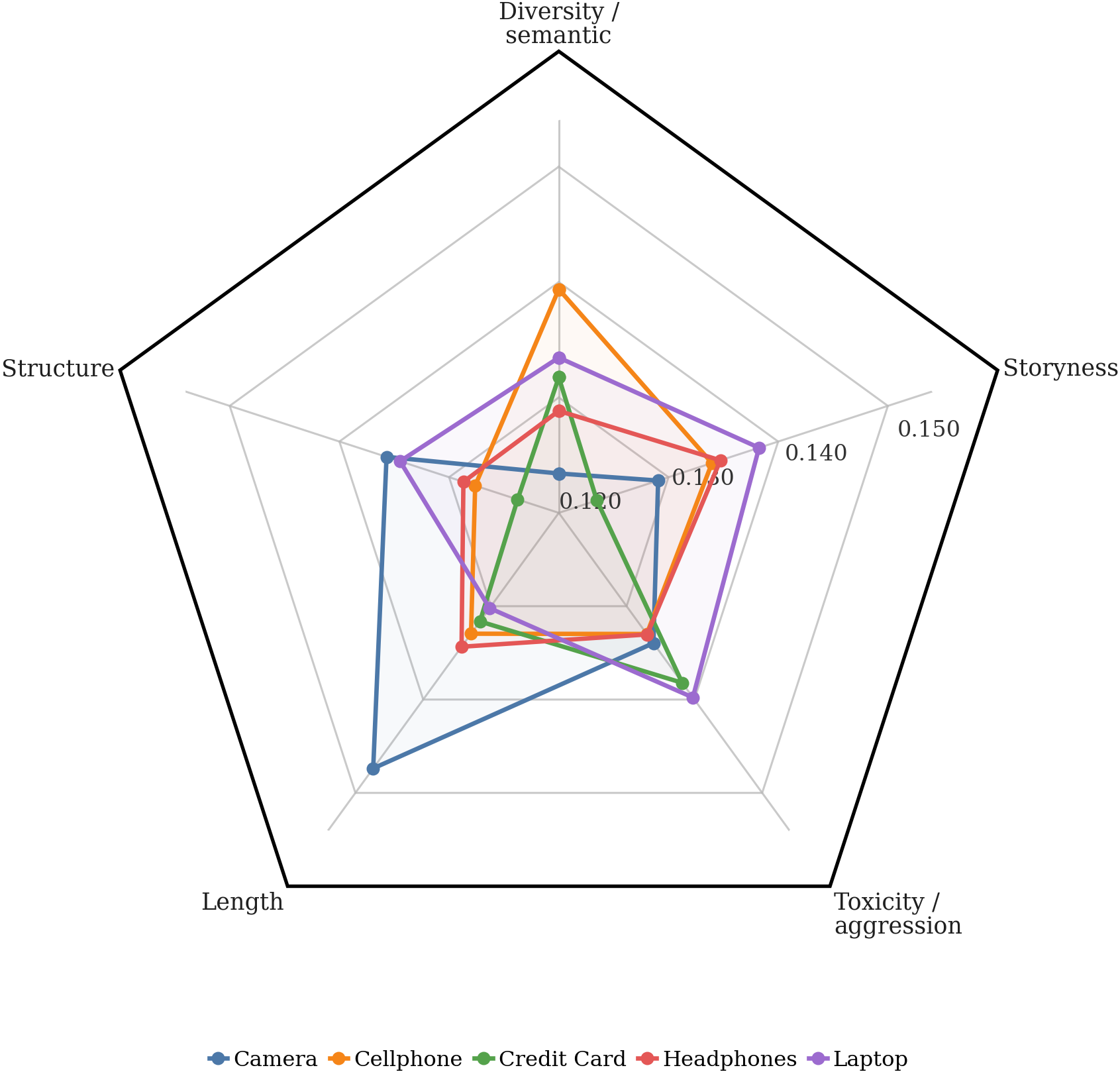
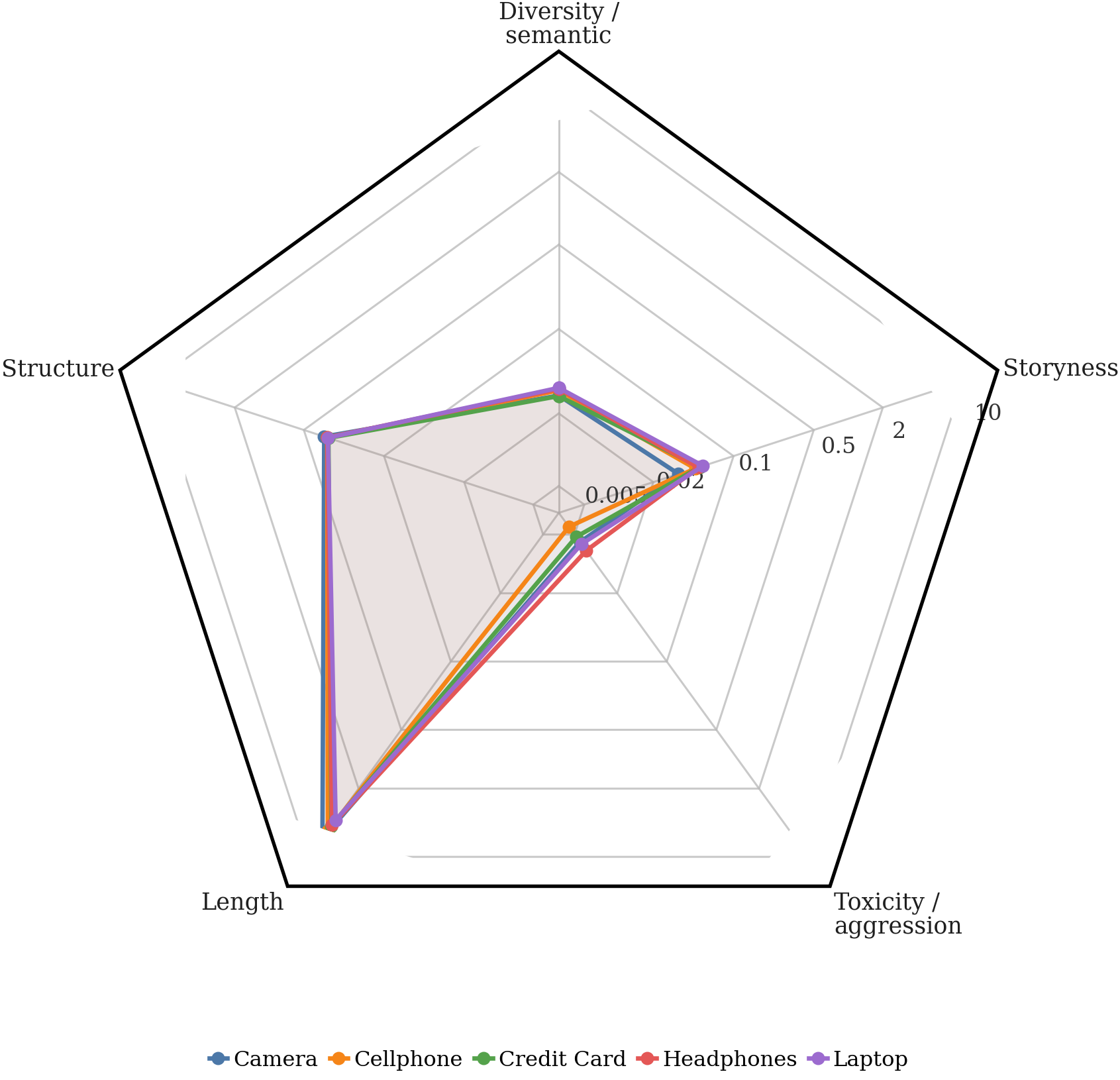
LLM agents are increasingly used to simulate human behavior and online communities. But existing work measures individual responses, role-playing, or task performance — not whether a set of generated conversations matches the content and reply-tree dynamics of real ones. MiroBench is a Reddit discussion benchmark built from 4,292 real threads across five domains, evaluating both comment-derived signals and thread structure.
LLM-based agents are increasingly used as simulators of human behavior, social interaction, and online communities. The promise: a controllable way to study how people discuss products, react to events, exchange opinions, and form group-level patterns.
But generating conversations is not enough. Existing studies focus on individual responses, controlled role-playing, or task performance in simulated environments — not whether a set of simulated discussions reproduces the content patterns and interaction dynamics of real ones, or compares progress across systems.
Reddit discussions are a practical setting for this measurement: public, topic-grounded, and multi-party. They carry advice-seeking, personal experience, disagreement, emotional tone, repeated talking points, and complexity in structure — an observable window into broader social behavior.
MiroBench combines 4,292 real Reddit threads with matched train / validation / test splits, standardized seed contexts, and a framework that compares generated and real discussions through both comment-derived signals and reply-tree structure.
Current simulators remain distributionally mismatched to real Reddit threads even when individual comments look fluent. Prompt-based improvement only partly closes the gap. The leaderboard below makes that gap concrete, family by family.
| # | Method · Model | Diversity | Tone | Structure | Content | Toxicity | p > 0.05 ↑ |
|---|---|---|---|---|---|---|---|
| — |
Real reference
held-out test · 200 repeated samples
|
W₁ 0.016
|δ| 0.060
|
W₁ 0.034
|δ| 0.071
|
W₁ 0.165
|δ| 0.100
|
W₁ 0.074
|δ| 0.098
|
W₁ 0.004
|δ| 0.043
|
— baseline — |
| 1 |
OASIS
DeepSeek-V4-Flash
|
W₁ 0.162 ×10.1
|δ| 0.669 ×11.2
|
W₁ 0.187 ×5.5
|δ| 0.472 ×6.6
|
W₁ 1.028 ×6.2
|δ| 0.768 ×7.7
|
W₁ 0.192 ×2.6
|δ| 0.318 ×3.2
|
W₁ 0.006 ×1.5
|δ| 0.132 ×3.1
|
23 / 80
28.7%
|
| 2 |
OASIS
DeepSeek-Chat
|
W₁ 0.165 ×10.3
|δ| 0.647 ×10.8
|
W₁ 0.177 ×5.2
|δ| 0.447 ×6.3
|
W₁ 1.044 ×6.3
|δ| 0.778 ×7.8
|
W₁ 0.269 ×3.6
|δ| 0.496 ×5.1
|
W₁ 0.006 ×1.5
|δ| 0.164 ×3.8
|
12 / 80
15.0%
|
| 3 |
OASIS
GPT-5-mini
|
W₁ 0.189 ×11.8
|δ| 0.680 ×11.3
|
W₁ 0.276 ×8.1
|δ| 0.630 ×8.9
|
W₁ 1.051 ×6.4
|δ| 0.777 ×7.8
|
W₁ 0.492 ×6.6
|δ| 0.760 ×7.8
|
W₁ 0.008 ×2.0
|δ| 0.228 ×5.3
|
7 / 80
8.8%
|
| 4 |
OASIS
GPT-4o-mini
|
W₁ 0.261 ×16.3
|δ| 0.830 ×13.8
|
W₁ 0.283 ×8.3
|δ| 0.611 ×8.6
|
W₁ 1.093 ×6.6
|δ| 0.811 ×8.1
|
W₁ 0.194 ×2.6
|δ| 0.509 ×5.2
|
W₁ 0.010 ×2.5
|δ| 0.703 ×16.3
|
3 / 80
3.8%
|
| — |
OASIS
Gemini 2.5 Pro · pending
|
— | — | — | — | — | — |
| — |
OASIS
DeepSeek-V3.2 · pending
|
— | — | — | — | — | — |
Family columns show per-family averages across 5 domains: W₁ is the Wasserstein distance between generated and real Reddit distributions (lower = closer to real); |δ| is the absolute Cliff's-δ effect size. The small ×N next to each value is the model's ratio over the real reference — how many times the real-vs-real noise floor it is. ×1.0 would mean indistinguishable from sampling more real data.
The top Real reference row is computed from 200 repeated sub-samples drawn from the held-out test split — not a single train/test split — so the floor accounts for sample-size variance.
Note on Structure. For structure metrics (avg_depth,
structural_virality, length_cv),
real Reddit threads have larger values than current LLM outputs — bigger is closer to real. The W₁ and |δ|
columns still measure distance (so lower is still better), but the underlying gap is one-sided:
LLMs under-build thread structure.
The p > 0.05 column counts (metric × domain) cells where Mann–Whitney U cannot reject equal distributions, out of 16 metrics × 5 domains = 80 cells. All models run under OASIS with the same task setup.
These figures show the noise floor of the benchmark itself — i.e., the gap you observe when comparing one half of real Reddit data to the other half. Any model's score should be read against this floor. These figures are not part of the leaderboard; they characterise the measurement.
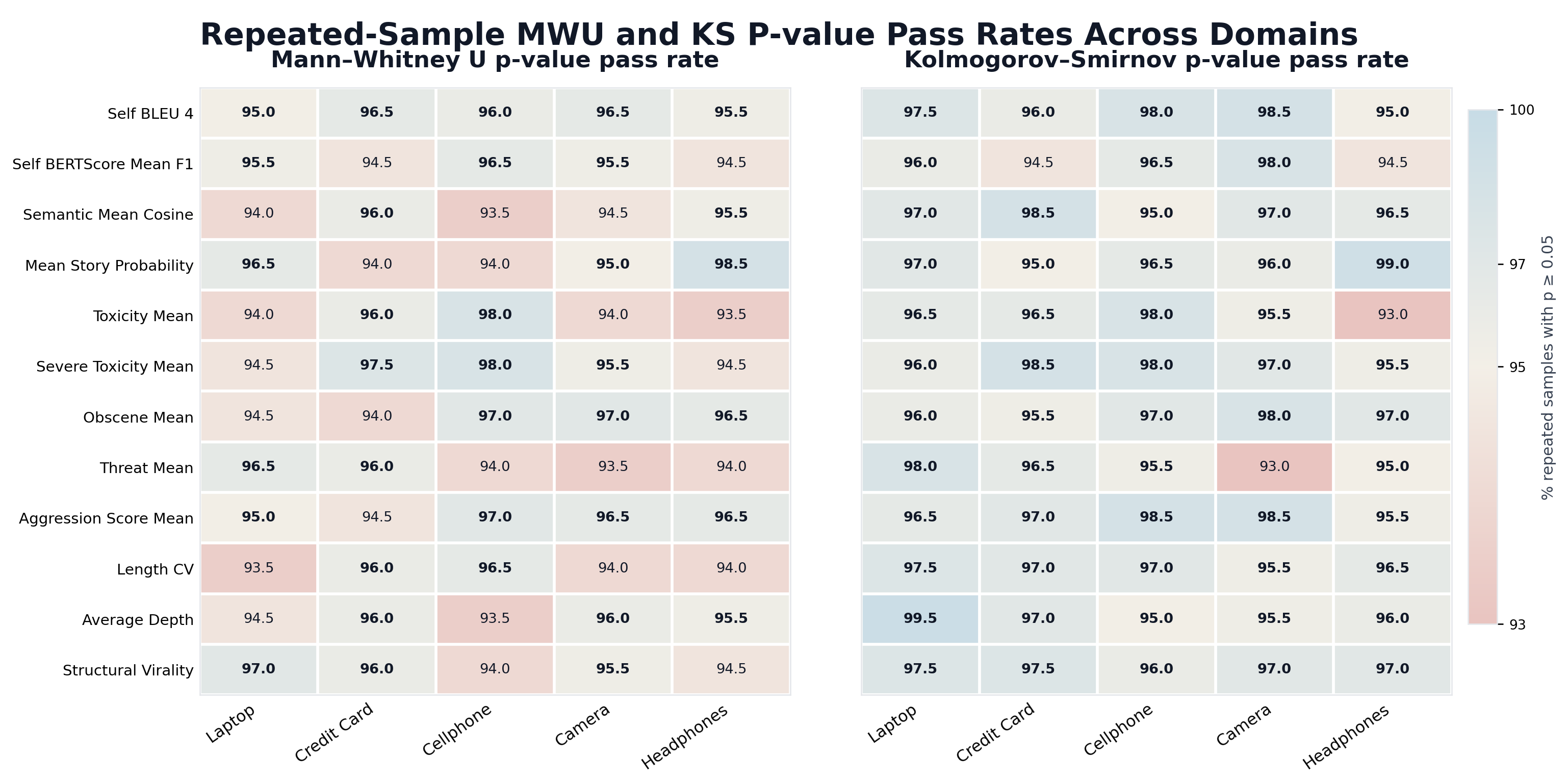
Repeatedly drawing two equal-sized samples from the real distribution and running Mann–Whitney U / Kolmogorov–Smirnov: ≈95% of comparisons return p > 0.05, which is the false-positive rate we should expect by construction. This is the "100% match" line that no model has approached.
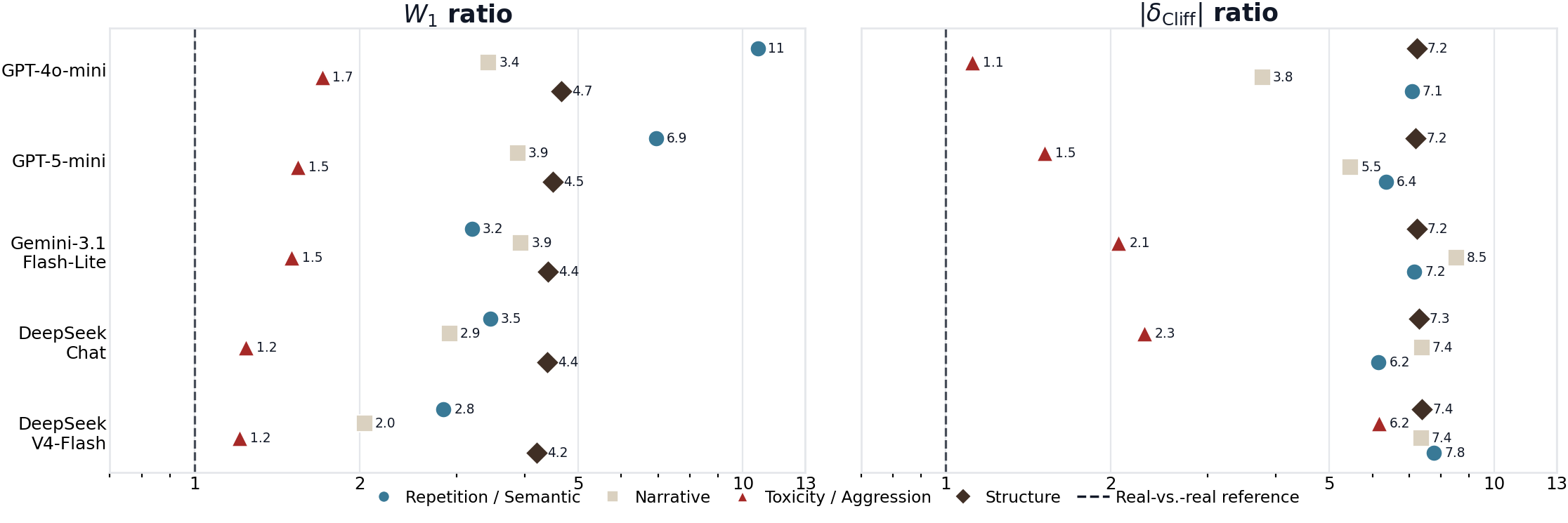
For each family, the dotplot shows the ratio of a model's average W1 (and |δ|) to the real-vs-real baseline. A ratio of 1.0 would mean a model is indistinguishable from sampling more real data; current models sit at 2×–11× the floor, with the largest gaps on Structure and Repetition.
$ git clone https://github.com/yyu6/MiroBench.git $ cd MiroBench $ pip install -e .
# each thread = directory with a discussion.json $ mirobench score my_threads/ --device cpu
$ mirobench compare my_threads/thread_scores.csv \ --core-only \ --model-name "my-model"
We also welcome citations from any work that builds on the data, the evaluation framework, or the reference distributions released with this benchmark.
@article{yu2026mirobench, title = {MiroBench: Benchmarking Realism in Agentic Simulation of Real-world Discussions}, author = {Yu, Yaoning and Yu, Ye and Luo, Haojing and Wang, Haohan}, year = {2026}, url = {https://github.com/yyu6/MiroBench} }